
The 5Pointz lawsuit: from whitewashed walls to a $6.75 million award

The 5Pointz lawsuit was a federal case brought by aerosol artists after the owner of a Queens warehouse complex whitewashed their murals in November 2013. In February 2018 Judge Frederic Block awarded 21 artists $6.75 million under the Visual Artists Rights Act (VARA): $150,000 for each of 45 works. The Second Circuit upheld the award in 2020, in Castillo v. G&M Realty L.P., and the Supreme Court declined to hear the case.
What 5Pointz was
The site began in the early 1990s as Phun Phactory, a set of run-down warehouses in Long Island City whose walls nobody curated. In 2002 the owner, Gerald Wolkoff, put the aerosol artist Jonathan Cohen, known as Meres One, in charge of them, according to the court's 2018 decision. Nothing was put in writing. Wolkoff set three verbal rules: no pornography, no religious content and nothing political.
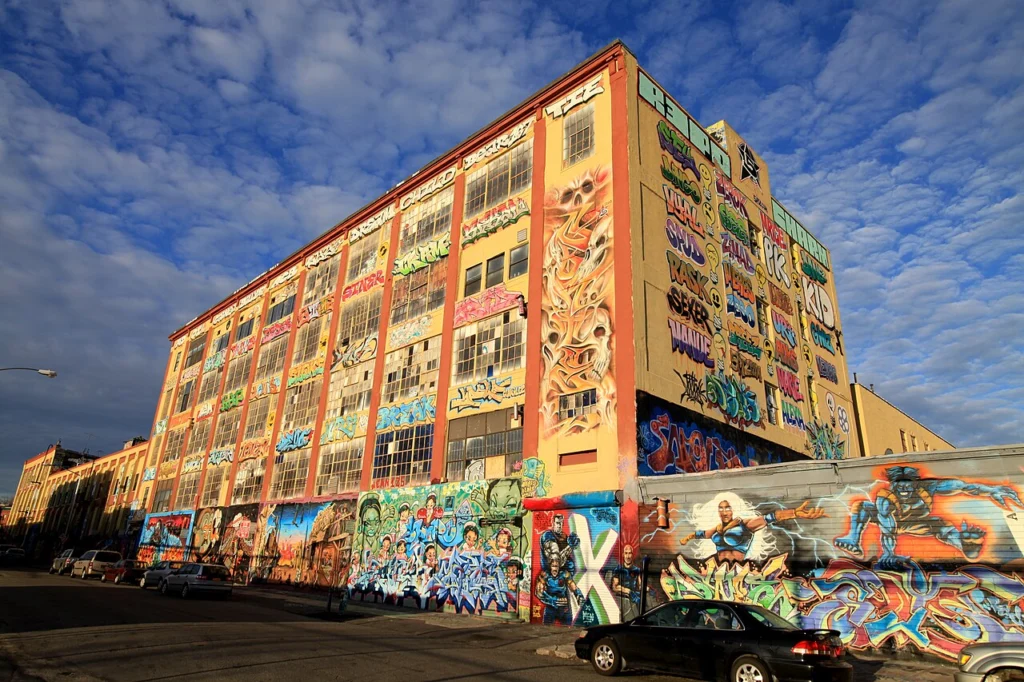
Cohen split the walls into "short-term rotating walls," where pieces lasted days or weeks, and "longstanding walls" kept for the strongest work. The appeals court counts about 10,650 works over the site's life and notes that it drew thousands of visitors a day. According to the 2018 decision, artists prized three kinds of space: walls facing the passing 7 train, seen by millions of commuters; walls near the loading docks, which had the most foot traffic; and the walls inside the buildings, which were generally long-standing.
Timeline of the case
| Date | What happened | Record |
|---|---|---|
| May 2013 | Cohen learns that Wolkoff is seeking city approvals to replace the buildings with luxury apartments | 2d Cir., p. 4 |
| Aug. 20, 2013 | The Landmarks Preservation Commission turns down protection because the art is too recent | 2018 decision, p. 21 |
| Oct. 2013 | A variance lifts the site's value from $40 million to more than $200 million, ending Cohen's bid to buy it | 2018 decision, p. 21 |
| Oct. 10, 2013 | Cohen and other artists sue in federal court in Brooklyn | 2017 order, p. 4 |
| Oct. 17, 2013 | Temporary restraining order | 2017 order, p. 4 |
| Nov. 12, 2013 | Preliminary injunction denied in a short order; that night Wolkoff bars the artists from the site | 2d Cir., p. 5 |
| Night of Nov. 18, 2013 | The walls are painted over; the artists' lawyers tell the court the next day | 2013 memorandum, p. 2 |
| Nov. 20, 2013 | Written opinion explaining the denial | 2013 memorandum |
| June 3, 2015 | Maria Castillo and eight other artists file a second suit | 2017 order, p. 4 |
| Mar. 31, 2017 | Tort claims dismissed; the VARA claim goes to trial | 2017 order, p. 14 |
| Nov. 15, 2017 | After a three-week trial, an advisory jury finds violations for 36 of 49 works | 2d Cir., p. 6 |
| Feb. 12, 2018 | Judge Block finds 45 works protected and awards $6.75 million; judgment is entered on Feb. 21 | 2018 decision; Mar. 6 order |
| June 13, 2018 | Post-trial motions denied | June 2018 decision |
| Feb. 20, 2020 | The Second Circuit affirms; the opinion is amended the next day to reword one sentence | Amended opinion |
| Oct. 5, 2020 | The Supreme Court denies the owners' petition, No. 20-66 | Docket |
In its 2013 opinion the court had called the case "the first occasion that a court has had to determine whether the work of an exterior aerosol artist—given its general ephemeral nature—is worthy of any protection under the law."
What VARA protects, and what "recognized stature" means
VARA, added to the Copyright Act in 1990, gives the author of a work of visual art, such as a painting or sculpture, two moral rights that survive a sale: attribution and integrity, as the 2018 decision puts it. Attribution is the right to be named as the author, or not. Integrity is the one at stake here: under 17 U.S.C. § 106A, the artist can prevent intentional distortion or mutilation that would harm their honor or reputation, and can "prevent any destruction of a work of recognized stature." Any "intentional or grossly negligent destruction" of such a work violates that right.
The statute never defines recognized stature. The Second Circuit did, on page 13 of its opinion: a work qualifies "when it is one of high quality, status, or caliber that has been acknowledged as such by a relevant community." That community is usually the art world, meaning historians, critics, curators, gallerists and other artists. Outside rare cases of obvious fame, "expert testimony or substantial evidence of non-expert recognition will generally be required."
Three points from the opinion decided this case:
- Temporary work counts. "We see nothing in VARA that excludes temporary artwork from attaining recognized stature," the court wrote. It pointed to Christo and Jeanne-Claude's The Gates, 7,503 orange gates that stood in Central Park for two weeks in 2005.
- The curator's choice is evidence. Cohen reviewed an artist's portfolio and a plan for the piece before allowing it to be painted. The court treated selection by a respected aerosol artist, and display at a curated site, as evidence that a work had been judged worthy.
- Images can carry the proof. The artists' expert, Renee Vara, had not seen several works before they were destroyed and assessed them from photographs. The appeals court found nothing wrong with that.
The court also reached for a well-known example: "A Banksy painting at 5Pointz would have possessed recognized stature, even if it were temporary."
Why the whitewash was ruled willful
VARA has a rule for art on buildings. Under 17 U.S.C. § 113(d), an owner who wants to remove art that can come off the wall must give the artist written notice and 90 days to take it or pay for its removal. Art that cannot be removed without destroying it is unprotected only if the artist signed a written waiver when it went up. At 5Pointz there was no waiver and no notice.
The trial record showed that many works were salvageable. A conservator's exhibit listed 12 works the artists could have removed themselves, 9 they could have partly removed and 28 that needed a conservator and contractors, according to page 42 of the 2018 decision.
The appeals court defines a willful violation as one where the defendant "had knowledge that its conduct was unlawful or recklessly disregarded that possibility." Wolkoff admitted at trial that he knew about the VARA claims and had lawyers advising him. He testified that he chose "to hire people to whitewash[] it in one shot instead of waiting for three months." Asked whether he would do it again, he said he "would make the same decision today."
Judge Block rejected his explanation that he feared the artists would act illegally; Wolkoff conceded they had always followed the law. The judge called the whitewash "an act of pure pique and revenge for the nerve of the plaintiffs to sue." In the June 2018 ruling he added a further finding. Wolkoff's 2013 affidavit had said demolition was urgent, yet he had not applied for a demolition permit until four months after the whitewash. The judge called that a "conscious material misrepresentation" and said he would otherwise have granted the injunction.
How the $6.75 million was calculated
A VARA plaintiff can recover actual damages or statutory damages. 17 U.S.C. § 504(c) sets statutory damages at $750 to $30,000 per work, and lets the court raise them to as much as $150,000 per work when the violation is willful.
The court did not award actual damages. The artists' and the owner's experts disagreed on market value, and Judge Block found that he could not fix one reliably. He turned to statutory damages and weighed the factors used in copyright cases, setting aside one, the infringer's cooperation with sales evidence, which did not fit art that was destroyed rather than sold. On page 49 he concluded: "Therefore, the Court awards $150,000 for each of the 45 works, for a total statutory damages award of $6,750,000."
| Step | Figure | Where it comes from |
|---|---|---|
| Works whitewashed and sued over | 49 | 2018 decision |
| Advisory jury's findings | 36 works; recommended $545,750 actual plus $651,750 statutory damages | 2d Cir., p. 7 |
| Works the judge found protected | 45 (the jury's 36 plus 9 more) | 2018 decision, p. 6 |
| Award per work | $150,000, the willful maximum | § 504(c)(2) |
| Total | 45 × $150,000 = $6,750,000 | 2018 decision, p. 49 |
| Share per artist | $75,000 to $1,325,000 across 21 artists | 2018 decision, pp. 50–51 |
The same page explains why the willful finding mattered so much. "If he did not destroy 5Pointz until he received his permits and demolished it 10 months later, the Court would not have found that he had acted willfully," Judge Block wrote, adding that "a modest amount of statutory damages would probably have been more in order." Without willfulness, the ceiling for 45 works would have been $1.35 million, at $30,000 each. The award ran five times higher.
What the appeal and the Supreme Court settled
The owners argued that most of the works were temporary, that the trial judge looked at quality rather than recognition, and that the damages were excessive. The Second Circuit rejected each point. It found no clear error in the stature findings or in the willfulness finding, and no abuse of discretion in giving the maximum award. Nothing in the record, it said, showed the whitewash was needed before construction began.
The owners then asked the Supreme Court to take the case. The artists waived their right to respond, and the petition was denied on October 5, 2020, leaving the $6.75 million judgment in place.
What happened to the site
Demolition began on August 22, 2014, DNAinfo reported, to make way for two high-rise apartment buildings. In the 2018 decision, Judge Block noted that the walls could have stayed up for those ten months, giving the public a last look.
Wolkoff died at his home on July 17, 2020, at 83, QNS reported. That was three days before the owners' Supreme Court petition was filed. By then the 1,100-unit residential complex on the site, which he had named 5Pointz Towers, was nearly complete. The corner of Jackson Avenue and Davis Street as it looks today can be seen on Google Street View.
What the case does and does not decide
The ruling protects work that meets VARA's definition of visual art and has recognition beyond its wall, proven work by work. The 5Pointz pieces were painted with the owner's consent, on a curated site, with years of press and expert attention behind them. That kind of outside recognition is the endpoint of the long shift in street art from anonymity to recognition. Unauthorized tags were not part of the case.
It also shows how owners and artists can avoid a fight. Judge Block noted that "all this could have been easily avoided with a written waiver of the artists' VARA rights up front, as § 113(d) expressly contemplates." None of this is legal advice; the rulings linked above are the authority.
Keep reading