
Stencil Graffiti: Technique, History, and Key Artists

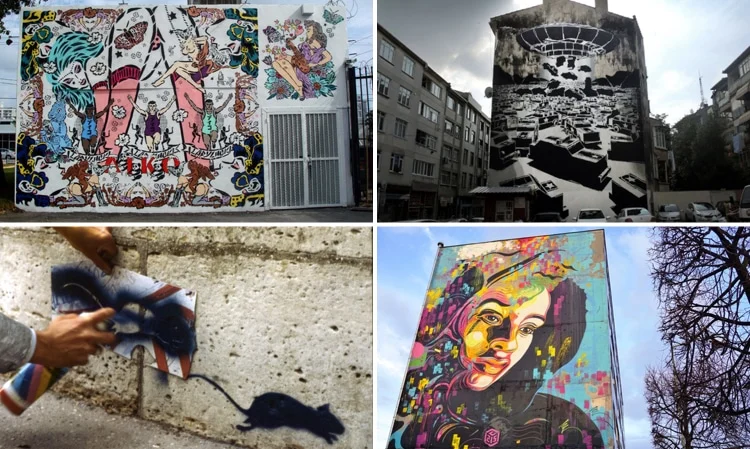
Stencil graffiti is a cut-and-spray technique that lets an artist repeat a hard-edged image quickly on a wall. It begins with a drawing on paper, moves to cutting a reusable template, and ends with thin coats of spray paint. The method suits artists who want consistency without painting freehand every time, and it rewards planning over speed. The sections below cover definition, origins, step-by-step practice, a key example, and the letterforms that make the style easy to recognize.
What Is Stencil Graffiti?
Stencil graffiti is street art made from a reusable template. The artist cuts open areas into a sheet of card, acetate, or thin plastic, then applies spray paint so the color passes only through the openings. The result is a hard-edged image or letterform that can be repeated at different sites. Stencil art differs from freehand graffiti because the design is prepared away from the wall; the surface itself is not drawn on for long periods. The approach favors control and speed, which made it useful for both legal commissions and unauthorized pieces on busy streets. Because the template is reusable, one artist can produce multiple near-identical marks, a quality that connects the technique to early political posters and, later, to the visual identity of artists such as Blek le Rat.
Origins: From Blek le Rat to Banksy
Tristan Manco's 2002 survey Stencil Graffiti traces the Paris emergence of the technique to the work of Xavier Prou, known as Blek le Rat, in the early 1980s. Before that, stencil marks existed in commercial lettering and political campaigns, but Blek le Rat turned them into a recognizable street practice: small, repeatable figures placed at eye level and left without a signature. His work moved street art from a private gesture toward a public conversation. The longer arc from cave paintings to city walls is treated as part of the origins of street art, while the shift from an unsigned tag to a named artist is the subject of the evolution from anonymity to recognition.
Banksy brought the method to a wider audience in the 2000s by combining stencils with printed captions and screen-ready compositions. The shift is often attributed to a desire for faster execution and to the precision needed for figurative images in contested public space.
A short timeline of stencil graffiti
- Early 1980s, Paris: Blek le Rat cuts and sprays small-scale stencil figures at street level.
- 2002: Tristan Manco publishes Stencil Graffiti, documenting the movement in book form.
- 2008, London: Banksy's One Nation Under CCTV is reported on a wall in central London.
One reason stencil graffiti spread quickly is that a single template can be carried flat in a folder and used again in another city. The work also photographs well, because the hard edges hold up in prints and on screens. Banksy's later pieces often layer a stencil over a photographed or painted background, which gives the image depth without losing the crisp outline.
How to Cut and Spray a Stencil
This sequence assumes a simple single-layer design; multi-layer stencils follow the same principles and add one template per color.
Materials
A basic kit includes a cutting mat, a craft knife or scalpel, a rigid sheet of card or acetate, low-tack spray adhesive or masking tape, and low-pressure acrylic spray paint with a fine cap. Card is cheaper and easier to cut, but it softens with repeated use; acetate lasts longer and resists paint build-up. Many artists use a low-pressure acrylic such as Montana Gold or an equivalent, but the cap matters more than the brand. Ready-made stencils are sold by specialist shops such as Stencil Revolution for artists who want to start with someone else's drawing. For a broader comparison of paints and surfaces, see the street art materials guide.
Cutting the stencil
Begin by drawing the design on paper at the final size. Keep the image simple: large shapes read better than fine details, which can tear or clog. Transfer the drawing onto the stencil sheet, then cut the open areas with the knife held at a right angle. Work from the center outward so the sheet stays rigid. If a shape has an interior hole, leave a thin bridge from the hole to the outer edge; the bridge holds the floating piece in place. Move the sheet rather than the knife when turning curves, and keep the waste pieces attached until the final pass. Before cutting, check that the sheet is clean and free of oil, because fingerprints can stop paint from adhering later.
Spraying the design
Work outdoors or in a ventilated space with a drop sheet behind the surface. Test the spray on scrap before the wall. Fix the stencil flat with adhesive or tape so the edges do not lift. Spray from about 15–20 cm away in short, light passes, and build the image with two or three thin coats, allowing each coat to dry enough to lose its shine before the next. Remove the stencil while the last coat is still slightly wet, pulling it straight away from the wall to prevent smearing. Clean the sheet with a solvent suitable for acrylic paint, dry it, and store it flat. Wind can push the stencil away from the wall, so wait for calm conditions or add extra tape around the corners.
Key Example: One Nation Under CCTV by Banksy
One Nation Under CCTV is a stencil work attributed to Banksy and reported in 2008. The piece applies the cut-and-spray method to a political caption, which is typical of Banksy's approach: the stencil provides the image, and the text supplies the layer of commentary. The work's power comes from the contrast between the hard-edged painted figure and the surrounding wall. Using a stencil allowed Banksy to produce the figure with clean outlines and to place it quickly, which matters when a wall is exposed and a piece may be removed the same day. It was reported in 2008; no recent source confirms whether it remains on the wall. For the full account, see One Nation Under CCTV.
How to Recognise Stencil Letterforms
Stencil graffiti letters are easy to identify at close range. The edges of each letter are hard, not soft, because the paint stops exactly where the template was cut. Most stencil letterforms include small gaps, called bridges, where the template held an interior shape in place; on a wall, these appear as thin unpainted lines crossing the letter. The contrast between the open shape and the surrounding negative space is more uniform than in freehand lettering, which varies with hand pressure. Because the same template repeats, repeated letters in the same piece often keep identical proportions. This regularity is the fastest clue that a piece was cut, not drawn. For related terms, see the urban art glossary.
FAQ
How to do stencil graffiti? Cut the design into card or acetate, fix the stencil flat to the wall, and spray with short, light coats; lift it carefully before it sticks.
What is stenciling work? Cutting a reusable template so paint or ink passes through the open areas and repeats an image or letter.
What spray paint is best for stencils? Low-pressure acrylic spray paint with a fine cap; many artists use Montana Gold or an equivalent, but no single brand is recommended without a source.
Where can I buy graffiti stencils? Online and specialist art shops, such as Stencil Revolution, although cutting your own from card also works.
Sources
Manco, Tristan. Stencil Graffiti. Thames & Hudson, 2002. Source for the early-1980s Paris dates. Stencil Revolution. Banksy stencils collection. Accessed November 2026. Source for current stencil products.
Keep reading